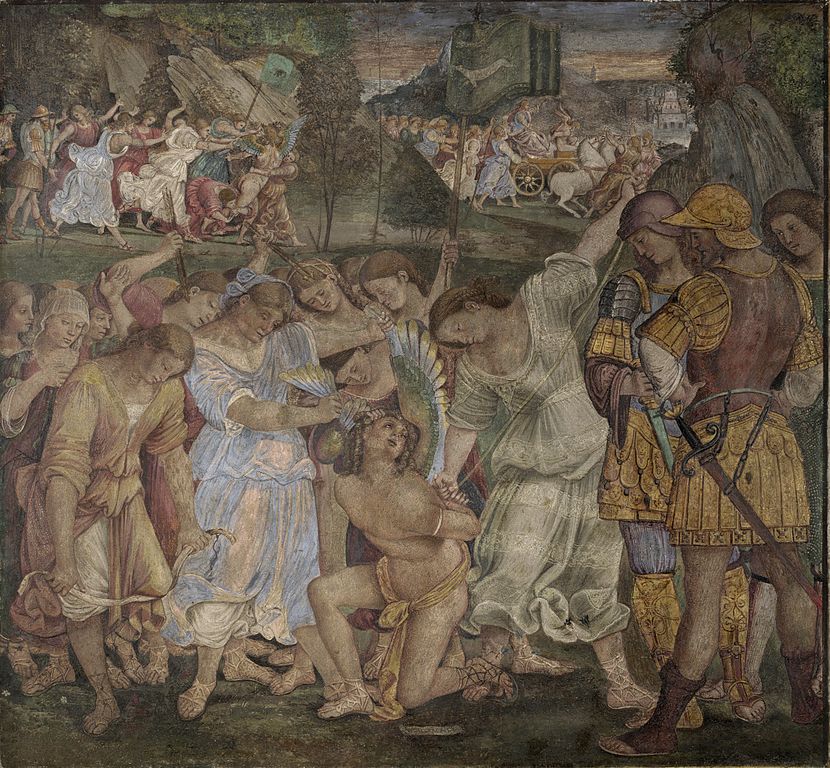
Six months ago, Ross Caldwell reported on a new finding by Thierry Depaulis. (Florence 1440 – New Earliest Reference to Tarot.) Ross provided the essential details from the document and some contextual information to indicate the significance of the finding. We will start there, then discuss several aspects of Franco Pratesi’s recently posted research, adding some comments and images of 15th-century decks related to the finding, some other associated artwork, and because it’s a long post we will indulge two rounds of mocking the Credentes: one with Bosch’s Haywain and the other with Bruegel’s Everyman and Nobody.

§1. Gismondo’s naibi a trionfi

Thierry Depaulis has found a new reference to Tarot from Florence in 1440, two years earlier than the previously known earliest reference, from Ferrara in 1442. The source is the diary of the Anghiara notary and public official Giusto Giusti, which covers the years 1437 to 1482, recently edited for the first time by Nerida Newbigin, professor emerita of Italian Language and Literature at the University of Sydney. An entry for 16 September, 1440, reads (p. 66): Venerdì a di 16 settembre donai al magnifico signore messer Gismondo un paio di naibi a trionfi, che io avevo fatto fare a posta a Fiorenza con l’armi sua, belli, che mi costaro ducati quattro e mezzo. (Friday 16 September, I gave to the magnificent lord sir Gismondo, a pack of triumph cards, that I had made expressly in Florence, with his arms, and beautifully done, which cost me four and a half ducats.)
"Gismondo" is Sigismondo Malatesta. Other notable details are the location where the cards were made, Florence; the unique term "naibi a trionfi"; and the price of four and half ducats.
It has been 138 years since Giuseppe Campori published the earliest known reference to Tarot cards – "carte da trionfi" – in the account books of the ruling Este family in Ferrara – and since 1874, research, both accidental and determined, has found many more references to the cards and the game of Triumphs, all of them after this previously earliest documented reference on 10 February, 1442. The picture of the game of Tarot's spread in the 15th and subsequent centuries has been amply filled out - more, perhaps, than for any other 15th century card game - but with this new discovery a little light is beginning to be shed on an earlier time.
Florence 1440 - New Earliest Reference to Tarot (Emphasis added)
http://forum.tarothistory.com/viewtopic.php?f=11&t=773

Sigismondo Pandolfo Malatesta (1417-1468) is the first known Tarot enthusiast.
 |
In itself, that is an interesting factoid but an anecdote of little historical significance. Gizmo(1) played cards – big deal. However, other aspects of Giusti’s record are extremely significant. Giusti’s document shows Gismondo to have ordered (or to have been given as a personal gift) a Tarot deck con l’armi sua – with his personal heraldry. The only thing special about the deck is the customization. It would make no sense to describe such a personalized Tarot deck unless the game and deck were already established. If the deck were unusual, then its novelty would be noteworthy. This seems to imply that naibi or carte da trionfi constituted a known game played with a standardized deck by late 1440. Among other things, this lends credence to the 1441 dating of the Cary-Yale deck which some writers endorse. And the deck was made in Florence.
Taken together, the Giusti details indicate that by the early 1440s, 1) Tarot was established as a card game and 2) as a standardized deck of cards 3) in several major cities. Milan and Ferrara were already known as early sites of the game, with Bologna and Florence suspected; now Florence is confirmed. While not surprising – this is exactly what some had long-since concluded based on evidence already known – this new finding supports those conclusions, reconfirming what Ross has termed the “Standard Model” of Tarot history.
 |
Regarding Sigismondo himself, the fact that he was fond of Tarot was already well-known. In an article concerning the Visconti-Sforza Tarot deck (“Six XV-Century Tarot Cards: Who Painted Them?”, Artibus et Historiae, Vol. 28, No. 56, 2007, pp. 15-26), Michael Dummett pointed out:
From a letter of 1451 from Bianca Maria Visconti to her husband Francesco Sforza, asking him to send to Sigismondo Malatesta, lord of Rimini, a pack of Tarot cards of the kind made in Cremona, which he had asked for the previous autumn, we may infer that Cremona was especially renowned for hand-painted playing cards of this kind.
Dummett’s source for that information, Winifred Terni de Gregory, (Bianca Maria Visconti, duchessa di Milano, 1940), discusses the Bembo family of painters. She refers to the elder Giovanni as head of the Bembo household, of the family workshop, and of the Bembo school of painters. She suggests that his sons, Benedetto and Bonifazio, may both have been involved in painting the Visconti-Sforza deck – one for the original commission and the other for the six replacement cards some years later. In any case it is known that the Visconti-Bembo style of Tarot deck was copied repeatedly. Depaulis’ new documentation shows that Sigismondo was both an early adopter, buying a customized deck from Florence in 1440 and a long-term enthusiast, acquiring the most stylish of gilded decks from Milan/Cremona more than a decade later.
|

§2. An Outbreak of Indifference
Two weeks ago, an article by Franco Pratesi was posted to the Tarot History Forum (THF). The research he reports explores the facts as well as the background and context of this earliest documentary reference to Tarot, the Giusti documents themselves. Pratesi begins, however, by lamenting the reception which this new finding has encountered online, specifically at THF.
The news was of such importance for the history of tarot that I expected a remarkable outbreak in the discussion about the origins and early spread of tarot in this forum, which several experts consider as the most serious on the subject. What happened is easy to outline. There have been only twenty-three posts up to now.... [The anticipated “remarkable outbreak” did not occur.] Was the news as trifling as to justify such a short discussion? I better suppose that it is instead the tarot community, which is not interested enough in the real history of their singular game, paying more attention to legends than to historical evidence.
First, let us affirm Mr. Pratesi’s insight re Tarot fora. They generally suck. On the other hand, as long as Ross is posting at THF, it is a place where real findings are shared with the online world.
(TIP FOR THF: Logon; click Members; click Ross G. R. Caldwell; click Search user's posts.
Valuable posts are either by Ross or commented upon by Ross.)
Still, it is not at all clear what outbreak of discussion should have ensued. On one hand, it must be expected that a new origin myth will be created. The classical (Pagan) affectations of Sigismondo’s Tempio Malatestiano and his hostility toward papal authority, and papal hostility toward Gismondo, are real and lavishly documented. These will provide ample excuse for another recycling of the Tarot folklore about Renaissance-magi and Neoplatonic humanism. Such historical fiction and iconographic imposition have been New Age staples since the 1970s. On the other hand, those are presumably the sort of “legends” which Pratesi referred to as competitors with “real history”.

The Haywain – A Triumph of Straw
The Emperor, Pope, and Everyman in procession.
The Giusti finding is, of course, a wonderful addition to the very fragmentary information available about the first years of Tarot. This quote is not only the earliest bit of evidence but also, aside from the Visconti decks themselves, perhaps the most dramatic: Giusti mentions a custom Tarot deck for a very famous Renaissance ruler. This is certainly a big deal.
However, Giusti’s passage does not say to the historians, “you were wrong: here’s better information!” The fact that Sigismondo acquired an expensive, personalized Tarot deck in 1440 does not push back the date of Tarot beyond what was already understood to be likely, nor does it change the area in which early Tarot was known to be popular. Customized luxury decks are well-known, and this does not even add a new name to the list of Tarot enthusiasts – Sigismondo’s taste for the game was already documented. There is little surprise here.
Any new reference to Tarot from Ferrara, Bologna, Milan, or Florence, from the late 1430s or later, would not change the big picture much. It would not contradict our previous understanding of early Tarot history. Quite the contrary, this new information confirms the version of Tarot history which has been told by playing-card historians like Depaulis, Pratesi, and Caldwell for a generation: Tarot was a card game, invented in Northern Italy, sometime prior to 1442. It is yet another refutation of the occultists, and one more insult to Lothar Teikemeier’s heavily-promoted but fanciful 5x14 Theory.
A reference which suggested that early Tarot was an esoteric manifesto of some sort would be revelatory; one which confirms yet again that Tarot was a card game is not. A reference to Tarot from Lyon in the 1420s, for example, would rewrite Tarot history in a profound way; one that confirms Italy circa 1440 does not.
The only way the Giusti quote can fundamentally change the earliest history is if we assign an unwarranted significance to it. For example, some people previously considered Ferrara to be the best candidate for the invention of Tarot because the earliest known references came from Ferrarese account books. Some people previously considered Milan to be the best candidate for the invention of Tarot because the earliest extant decks came from the Milanese court. Some writers enjoy creating speculative narratives around isolated historical facts, weaving coincidental dates, places, people, and events into an elaborate tapestry of historical fiction. The Giusti quote certainly offers new opportunities for such creative writing, but that is shabby history.
The historical facts seem far too fragmentary to permit such specific conclusions. However, Pratesi goes on to say that it is important that this new finding receives proper attention. This post is my modest contribution toward that end. Even though I have little to add, I will restate some of what has been said, perhaps highlighting different sides.
|

§3. Giusto Giusti’s Journal
 |
The most pressing question, as is often the case with new historical findings, is whether the passage is legitimate. Did Gismondo order a customized deck of naibi a trionfi in 1440? (Or, just as revealing, was one ordered for him?) The text from which the passage is taken is a notary book of Giusto Giusti (1406-1483). Notaries journal every official act, and some of Giusti’s books survive. Such journals have obvious and varied historical value, so that later copies have been made. As Pratesi notes, these copies often entail a selection of entries from the original, or from a previous copy, with that selection being dependant on the interests of whoever made the copy.
Pratesi recounts much of the history of this copying and the various researchers who have studied them. Nerida Newbigin is the scholar who published the critical edition of the Giusti journals in 2002, based on five manuscripts. Pratesi reviewed the manuscripts and he reports that only one of the books (by Carlo Strozzi, made in the 1620s) contains the passage in question. This sounds discouraging but, given the selective nature of such copies, this fact is not dispositive. The transcription which contains the Tarot reference was made by a relatively competent writer, working from the original Giusti documents.
The specific phrase in question, naibi a trionfi, would almost certainly have been unknown at the time the copy was made. The rare terminology is confirmed as a mid-15th century Florentine usage by its only other occurrence. Pratesi notes, “an indirect confirmation of the real presence of this expression in the original text comes from my discovery of a very similar idiom – Naibi di Trionfi instead of Naibi a Trionfi – in an account book written in 1452, only a dozen years later.” That seems to preclude the possibility of an interpolation nearly two centuries after the fact: the reference is certainly real.
The quote seems conclusively authentic. That is, Giusti did record this event in 1440. The rare yet unsurprising combination of naibi with trionfi, and the association of Tarot with someone already known to have an interest in the game, combine to make the passage seem inescapably authentic. Additionally, there is no apparent reason why such an entry would have been invented at a later date – it would serve no purpose.
The name employed – un paio di naibi a trionfi – is one of the most interesting details of the short passage. It is a self-authenticating detail, as discussed above, but also informative in terms of Tarot history. As with other elements, it is both new and yet not surprising. The expression un paio refers to a deck of cards... at least in the U.S. (Otherwise it refers to a pack of cards.) The previous “earliest documented reference” was to the purchase of quattro paia di carticelle da trionfi. Dummett points out that, “as with early English sources, the word ‘pair’ (paro or paio) was often used to mean ‘pack’.” Pratesi posted an article detailing this topic a few weeks ago. The term naibi, in various spellings, is the common early name for playing-cards. The use of this term in connection with Tarot, naibi a trionfi, is rare, so far being found only in a few Florentine records. However, because naibi was the most common early name for playing cards, this earliest usage with regard to Tarot is one more knife in the corpse of the occultists. Pratesi notes:
...the mention of Trionfi together with Naibi is important, indicating that they were only considered as a variation of common card packs; namely, the same playing cards, just produced in a particular version. This may appear as an obvious observation, but people still exist who think of some miraculous birth of tarot.
Pratesi’s research into the records of silk traders provided the parallel example of naibi di trionfi, along with numerous other records of both regular playing-cards and Tarot. All of these recently publicized findings reinforce the larger history of Tarot that playing-card historians have been telling for decades: Tarot was a card game. Pratesi takes pains to make that point explicitly.
|

§4. Il Lupo: Signore di Rimini
 |
The Wolf of Rimini – clearly, Tarot’s first (known) patron is a famous historical figure. (Prominence would be expected from the mere fact that records survive about something as trivial as playing cards!) Gismondo was an Italian warlord (condottiere) and ruler of Rimini. He was the epitome of an Italian Renaissance prince. Such rulers were typically notable in politics and war as well as their personal life, the arts, and letters. Their loyalties tended to be fickle, and their personal lives self-indulgent. Regarding the arts, they served mainly as patrons and are known today by their commissions. Some of Sigismondo’s decorate this post. As for learning, they tended toward the humanistic fashions of the day, classical learning and Neoplatonic philosophy. This was Gismondo, whom Burckhardt summarized, saying, “unscrupulousness, impiety, military skill, and high culture have been seldom combined in one individual as in Sigismondo Malatesta”. The following nasty summary of Sigismondo is from the online Catholic Encyclopedia:
He was undoubtedly one of the worst tyrants of the Renaissance, without fear of God or man. At the same time, he shared to a high degree in the Renaissance cult of art and letters, and many humanists and poets found shelter at his court. The wonderful temple of San Francesco at Rimini, the most pagan of all professedly Christian churches, was built for him by Leon Battista Alberti; Piero de' Franceschi painted him as kneeling before St. Sigismund, and Pisanello cast his portrait in a splendid medal which is a masterpiece of its kind.

Sigismondo is accused of the murder of his two wives, Ginevra d'Este and Polissena Sforza. He afterwards married his mistress, the famous Isotta degli Atti, in whose honour he composed poems which are still extant. In 1465 he commanded the Venetian army in the unsuccessful campaign undertaken against the Turks in the Morea, and on this occasion he discovered the remains of Gemisthus Pletho (the Byzantine scholar who introduced Platonism into Italy), which he brought back with him to Rimini and solemnly enshrined in San Francesco. Pius II, who held him in peculiar abhorrence, partly because of his treachery towards Siena, had begun by degrees to deprive him of his dominions, and Paul II continued the same course until only Rimini itself remained. Infuriated at a demand to surrender Rimini also, Sigismondo went to Rome in 1468, with the intention of slaying the pope with his own hands. Either opportunity or resolution failed him. Paul seems to have pardoned him and even confirmed him in the possession of Rimini, but Sigismondo returned home a broken man, and died a few months later.

Tempio Malatestiano (As Envisioned)
Designed by Leon Battista Alberti
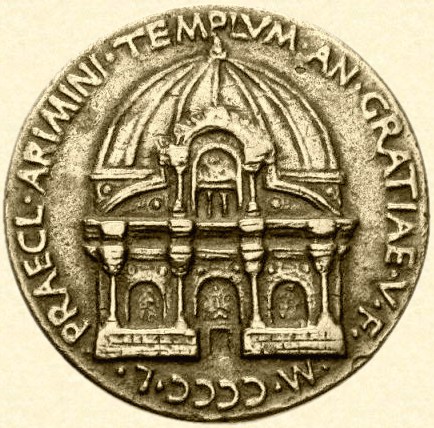
Gismondo’s most notable commission remodeled the Church of San Francesco in Rimini, commonly known as Tempio Malatestiano. Designed as one of the earliest works by Leon Battista Alberti (1404-1472), it is a landmark in Western architecture. Dramatic new features were the incorporation into its facade of a Roman triumphal arch. (The central archway was flanked by two blind arches.) Each side had seven arches, and a large dome was planned, as in the illustration above. The interior included bas-reliefs by Agostino di Duccio (1418-1481) and a famous fresco by Piero della Francesca (1415-1492), above. Some details will be discussed in the next section.

So now an appreciation for playing cards can be added to the wealth of information on Sigismondo. He commissioned special Tarot decks during the period of the game’s initial spread through Northern Italy. Highlighted on the map above are the some early centers of Tarot (red), including Cremona, and cities in the area of Sigismondo’s dominion (yellow).
|

§5. Malatesta Trionfi
The term trionfi can refer to many different things. This inherent ambiguity confuses some soi disant Tarot historians, who want to blur distinctions the way that occultists do. If something is called trionfi then it must, in their view, be connected with Tarot. In another recent post, Pratesi attempted to clear up a little of that confusion, and we’ll take a stab at that task in the next post here. The term itself, as a name for Tarot cards, is both an aspect of Depaulis’ Giusti quote and an umbilicus between Tarot and the 15th-century Italian society. Parallels can be observed without blurring distinctions.
 |
Triumphs are a central conceit of the Renaissance, and allegorical triumphs are the essence of Petrarch’s Trionfi and the Tarot trump cycle, carte or naibe da trionfi. So it is worth taking some time to discuss Gismondo and triumphs. Like most Renaissance rulers, Gismondo used trionfi to promote himself in various ways. Most importantly, there were actual military victories, triumphs in battle, and the political triumphs that came from these victories. This, more than anything else, determined the warlords’ fortunes in other realms. But there was also the iconography of triumphal propaganda. Like the rest of Gizmo’s life, this has been the subject of much research and writing. We’ll touch on a few details.
Alberti’s design for the Church of San Francesco was devoted to celebrating the greatness of Gismondo, especially in its facade. As seen in the dramatic medal created by Matteo di Andrea de'Pasti, the renovated church would have a dome visually merged with a classical triumphal arch. (The use of a three-portal triumphal arch is reminiscent, for example, of the 12th-century French church of Saint-Gilles.) The design was both spectacularly beautiful and a symbolic merging of the Renaissance values of Christian faith with humanist arts and letters. Unfortunately, like Nimrod’s Tower, it was never completed.

Tempio Malatestiano
Designed by Leon Battista Alberti
Various works inside the church were also designed to herald Gismondo’s glory. This edited description is from Pernis and Adams (Federico da Montefeltro and Sigismondo Malatesta: The Eagle and the Elephant, 1996.)
 |
The most striking examples of Sigismondo’s Triumph iconography are in the Tempio Malatestiano. They reveal aspects of Sigismondo’s grandiosity, his fondness for elusive disguise, and his love for Isotta. The marble relief, with Sigismondo’s portrait by Agostino di Duccio, for example, is carved on a pillar supported by two elephants at the entrance to the Chapel of the Madonna of the Water. Here Sigismondo is portrayed as a victorious general all’antica. His handsome features are rendered in pure profile, encircled by a laurel crown. The elephants can be read as carrying Sigismondo to eternal fame.
Inside the Chapel of the Madonna of Water is a Triumph of the Roman general Scipio, which is on the right side of the front of the Ark of Sigismondo’s Ancestors and Descendants. On the left side is the Temple of Minerva. Sigismondo appears on both reliefs, but is disguised as Sigismondo/Scipio. The inscription carved on the slab separating the two panels declares:
 |
SIGISMUNDUS PANDULFUS MALATESTA
PANDULFI F(ILIUS) INGENTIBUS MERITIS
PROBITATIS FORTITUDINIS(-)QUE ILLUSTRIS
GENERIS SUI MAIORIBUS POSTERIS(-)QUE
This associates Minerva with the virtue of Probitas and Scipio with Fortitudo. The Temple of Minerva is an elaboration of Albertian architecture combined with the more decorative taste of Sigismondo. Philosophers and warriors gather within the temple and Sigismondo is probably the young man wearing the cuirass all’antica who stands in front of the goddess. Framed by Minerva’s shield, the face of the young warrior occupies the space usually assigned to the Gorgoneion.
The implicit identification of Sigismondo with Medusa has biographical as well as iconographic meaning. [...] His head, framed as it is by the shield, recalls the profile discussed above which is encircled by an antique laurel wreath. It also suggests that the youth is literally “under the aegis” of Minerva; he has, in fact, become her aegis and, in so doing, has usurped the traditional role of the Gorgoneion....
|

 |
The second panel is the Triumph of Scipio. Pernis and Adams identify various sources for this, but Petrarch seems to be a recurrent favorite of Gismondo. The Triumph of Scipio is central to Petrarch’s Africa, which suggests other elements analogous to Gismondo’s circumstance: “In Petrarch’s text, in fact, there are a number of passages that resonate with the feuding fifteenth-century Lords of Rimini and Urbino, including the invectives they hurled at each other.” This is part of their description:
In the companion panel, the Triumph of Scipio, the image of Scipio the Younger with his eyes closed, as if in a dream, is again framed by a classical wreath. He is borne on a triumphal chariot driven by four horses – an honor assigned to distinguished generals in ancient Rome. The chariot passes through a triumphal arch with a single opening inspired by the Arch of Titus. Sigismondo’s initials on the richly decorated ceiling of the arch suggest that the protagonist should be identified as Sigismondo. The image of Sigismondo/Scipio is placed in the middle zone of the chariot within a laurel wreath, and the personification of Fame at the upper left of the relief trumpets his praise. The diagonal of her trumpet leaves the viewer in no doubt that Sigismondo is the recipient of her praise. Directly above him sits a noble personage, probably Scipio the Elder, who wears a toga over his cuirass. He holds a sceptre in his right hand and a palm branch in his left. His lion throne proclaims the antiquity of his ancestry and the legitimacy of his rule. In the iconography of the Tempio Malatestiano it is Sigismondo who claims descent from the Elder Scipio.
Perhaps the most shameless example of the theme of triumph inside the church has already been mentioned: a Triumph of Fame appears to carry a marble tomb with Gismondo’s face, haloed in a laurel wreath, on the backs of two elephants. This is a blunt instrument of apotheosis. The following passage is from Margaret Ann Zaho’s excellent book, Imago Triumphalis: The Function and Significance of Triumphal Imagery for Italian Renaissance Rulers. (Read the whole book.)
 |
At the entrance to the Chapel of the Ancestors is the second triumphal portrait of Sigismondo. It, too, attempts to incorporate antique concepts of honor and victory with Christian ones of Triumph and Fame. This triumphal portrait, which is quite different from the relief, is actually incorporated into the architecture of the chapel. The portrait serves as part of the base for the pilasters which support the chapel itself so that the pilaster rests on a pair of elephants who in turn support on their backs a portrait of Sigismondo. The elephant was a favorite impresa of Sigismondo and he had used it often, especially on the reverse of medals.
The portrait of Sigismondo is a profile bust encircled by a wreath of laurel. It shows an idealized image of the mature Sigismondo with his recognizable short cropped hair and aquiline nose. He is crowned with laurel that is tied together at the back of his head. The image immediately recalls the sculpted tondos with portrait busts that decorate Rimini’s Arch of Augustus.
Furthermore, the whole portrait tondo is enclosed within a marble square that recalls, in size and shape, the side of a sarcophagus. Because the tondo is set flush with the top of the heads of the elephants, the tondo seems to be being carried or borne by the elephants in a kind of procession. This pair of elephants is clearly meant to echo Petrarch’s use of elephants as the bearers of the Triumph of Fame. In this portrait it seems that Sigismondo has turned to Petrarch, in addition to antiquity, as a source for his triumphal imagery. The elephants, which here carry the image of Sigismondo, are in essence serving to perform for him a Triumph of Fame.
Sigismondo was certainly also aware that elephants had been used by Roman Emperors to pull triumphal chariots. Moreover, with the use of the elephants, he was reinforcing the link between himself and Augustus and the city of Rimini. In addition, Sigismondo was also again linking himself to Scipio Africanus, who after his defeat of Hannibal, included the defeated general’s elephants in his triumphal procession.
Another aspect related to the use of the elephants at the entrance to a family burial chapel again comes from Petrarch. Petrarch’s Triumph of Fame, which was drawn by elephants, is the Triumph in his series of five allegorical triumphs which vanquished death. This imagery works perfectly in association with a family burial chapel so that it is not just Sigismondo but the fame of the Malatesta family name which Triumphs over death.
|

§6. Tarot Folklore
As noted above, there is one area in which Pratesi’s wish, that Giusti’s quote get more attention, will almost surely be fulfilled. This new fact will be wedded to old fiction in the service of New Age pseudo-history. The hapless quote will be just another turd in the endlessly expanding manure pile.
Among the “facts” of which online Tarot “historians” are aware, we might begin with the legendary remarks of Jean Gerson, chancellor of the University of Paris in 1395, who spoke of a craze, “a passion among the population” at that time for pictures which showed the diis gentium (the gods of the nations) “not excepting Bel phegor”, and which were used for fortune-telling. They were used in this manner even in the churches and on festival days; obscene pictures were sold tanquem idola Belphegor, which corrupted the young, while sermons were ineffective to remedy this evil. This is the true nature of playing cards in 14th-century Europe, and the true origin of Tarot cards.
It has long been noted that the first Tarot deck (connected with the names Marziano da Tortona, Michelino da Besozzo, Filippo Maria Visconti) was based on Pagan gods. It is likewise common knowledge that Tarot was repeatedly banned by the Church, that the Major Arcana were thought to be rungs on a ladder to Hell, and that the deck was called the Devil’s Breviary by preachers. A sermon circa 1500 said that there is nothing in the world as offensive to God as Tarot, that it contained every disgrace to the Christian faith, and in no other game does the Devil triumph over the soul as in this one. All these things and more are known.
 |
Add to this Depaulis’ smoking gun, the Giusti passage, and the documented fact that the first and foremost ancient exponent of Tarot was a heretic who built a Pagan temple and fought with the Popes. Sigismondo was excommunicated and publicly burned in effigy by Pope Pius II. The condemnation was unique:
Until now, no mortal has been solemnly canonized in Hell. Sigismondo will be the first man worthy of this honor. By edict of the Pope, he will be condemned to the infernal city where he will join the damned and the devils. Nor will we wait for his death, for there is no chance of his repentance. He is hereby condemned, while still alive, to Orcus and eternal fire.
(Pius II, Commentarii, V, from Pernis and Adams.)
Pope Pius II and his successor, Pope Paul II, gradually took away Sigismondo’s territories, reducing his rule to Rimini. As noted above, Paul II eventually demanded Sigismondo surrender Rimini as well. The Pagan Prince™ went to Rome and attempted to murder Paul II. Instead, the Pope cleverly poisoned Sigismondo, who died in agony a few months later. (Purchase Tarot and the Pagan Prince at Amazon.com for your Yule Sabbat gift list.)
But wait – there’s so much more! Sigismondo is reputed to have been a Freemason, and scholarly articles have been written on the subject. Sigismondo married into both the Este and Sforza families, gaining intimate access to the two early centers of Tarot. When their purpose had been served, both women were murdered, while Sigismondo continued his longstanding relationship with the High Priestess Isotta degli Atti. They were later married.
All this is documented history. (Would I make this shit up?!) As Ross Caldwell pointed out to me, Sigismondo is also reputed to have belonged to both the Order of the Dragon and the Kappa-Sigma/Kiriath-Sefer societies. There are more secrets that should not be told, including a first-century manuscript with evidence about the God-kings of Europe and Outre-mer which even the Priory of Sion has not yet seen. Seriously, these tales should not be told. Yet all these facts, semi-facts, and mild embellishments can be collected and lines drawn from one to another.

Everyman and Nobody
Ransacking Garbage for Treasure.
Finally, there is the True, Ancient and Original Tarot, connected with the 42 Assessors of dynastic Egypt but best presented in the Tarot of Andrea Mantegna, also known to Albrecht Dürer, Ludovico Lazzarelli, et al. Although very different from both the ancient Assessors form of Tarot and from that described in the Greek Magical Papyri, the mysterious arcana of the Mantegna Tarocchi were the high-point of Tarot in the Renaissance.
Sadly, I didn’t make up all that shit. Several of the clowns writing such dreck consider themselves scholars. They will find Giusti’s record useful for their ends, no doubt.
§7. Florentine Tarot
Back on planet Earth, fifteenth-century Italian history is amazingly messy, with relationships, conflicts, and shifting allegiances beyond reckoning. Tarot was something shared by the four early centers of the game from the earliest years. Each center developed its own standard pattern which would later branch into a family of related patterns. There is little doubt that Tarot was invented in one of those four centers, and arguments have been advanced in favor of each. Giusti’s is the earliest mention of Tarot, and Gismondo’s deck is coming from Florence... does that mean Tarot originated in Florence?
Florence was always a sentimental favorite, or at least a contender by default, because of the enormous amount and variety of Renaissance art and literature which is associated with that city, as well as the concomitant vast research that has been produced. In his article, however, Pratesi alludes to some additional new evidence, yet to be made public, which will make Florence appear to be the center of early Tarot production and distribution.
It has been known for a long time that Naibi were documented in Florence already in 1377 and the names of a few cardmakers active in the town in early times have also been found. I could thus search for further information about these makers and their families (often the job passed from father to son). In the last months, however, I found so many names of Florentine cardmakers that I had to postpone my research on their families, possessions, and so on. Maybe, it will be possible to complete this task before entering my second life.

Idealized Cardmaking Workshop in Paris, 1680s (3)
The amount of makers, and especially the amount of their products was not comparable with any other Italian places - let me exclude here any comparison with the German and French productions of the time. When we search in Milan or Ferrara, we find one or two makers who produced a few packs of cards. Usually, this was not their only job. They provided the court with many other paintings for the most various uses and events. I am not able to think of them as producers of packs that could be delivered to far places in a recurrent way. The Florentine production had instead well established destinations along the channels of the age-old trades of the Florentine merchants.
There was not only this quantitative aspect. It was possibly accompanied by an artistic level that could not find a valid competition anywhere else (except for the superior quality of the German woodblocks). Typical of the Florentine production, at the top level, were the gilded cards. Even before the first mentions of Trionfi could be found, we read of special Florentine packs sent to Venice. I had already several opportunities to remind the known fact that valuable cards acquired for the Ferrara court actually came from Florence (exactly in the contrary direction to that suggested for the tarot spread).
Pratesi appears to have found ample evidence to conclude that Florence was, by far, the place where early Tarot went from a popular novelty into a more popular commodity. Everyday decks – a standard pattern printed with woodcut blocks – were produced, marketed, and distributed. While not as enticing a discovery for writers of historical fiction as the Giusti quote about Sigismondo, this is a hugely significant finding for the history of Tarot. This conclusion gives us information about the larger spread of the game rather than the continuing interests of a single prominent enthusiast.
The Venetian Quote (1441)
In 1760, the Italian architect Tommaso Temanza (1705-1789) discovered a 1441 Venetian trade ordinance. He recounted the substance of it in a letter to Count Francesco Algarotti (1712-1746). It has subsequently been repeated by every playing-card historian but rarely taken into account by Tarot enthusiasts, who focus on the extant hand-painted cards. This bias is reinforced by the limited documentary evidence and the fact that much of it also relates to the elite. Another possible justification for this oversight is the relative absence of early or frequent evidence of Tarot in Venice.
The central point, however, is not about Tarot nor Venice. It is the presence of printing technology in Italy, and its use at an early date to produce significant quantities of playing-cards. It cannot be emphasized too much that Tarot was not an esoteric manifesto, or some such bullshit, but a deck of playing cards. As such, they were needed in quantity. Playing cards had been popular enough to pose a problem in Europe for a half century before Tarot was invented. There has never been any reason to doubt the presence of printed Tarot cards in any city that played Tarot, because the deck and game were not invented until after printed cards had already established themselves in Northern Italy.
The passage appears in Raccolta di Lettere sulla Pittura, Scultura ed Architettura, Volume 5, letter CLXXIII, pp.320. The following translation is from Theodore Low de Vinne, with a significant correction from Ross:
1441, Oct. 11. Whereas, the art and [craft] of making cards and printed figures, which is in use at Venice, has fallen to decay, and this in consequence of the great quantity of printed playing cards and colored figures which are made out[side] of Venice, to which evil it is necessary to apply some remedy, in order that the said artists, who are a great many in family, may find encouragement rather than foreigners: Let it be ordained and established, according to the petition that the said masters have supplicated, that from this time in future, no work of the said art that is printed or painted on cloth or paper—that is to say, altar-pieces, or images, or playing cards, or any other thing that may be made by the said art, either by painting or by printing—shall be allowed to be brought or imported into this city, under pain of forfeiting the work so imported, and thirty livres and twelve soldi, of which fine one-third shall go to the state, one third to Giustizieri Vecchi, to whom this affair is committed, and one third to the accuser. With this condition, however, that the artists who make the said works in this city shall not expose the said works for sale in any other place but their own shops, under the penalty aforesaid, except on the day of Wednesday at S. Paolo, and on Saturday at S. Marco.
This too is a kind of confirmation of earlier knowledge. Online Tarot enthusiasts occasionally become obsessed with frivolous or long-since answered questions, such as the availability of paper, card stock, printing technology, and so on. Historically, all resources and technologies were in place to mass-produce Tarot decks before Tarot was invented. One of the most salient insights has been known to every Tarot researcher since 1978, when it was included in Stuart Kaplan’s Encyclopedia of Tarot. A 1441 order issued by the Magistery of Venice (as copied “in an old book of regulations which belonged to a fraternity of Venetian printers”), included crucial information. See the sidebar for the quote.
It may be that decks were mass-produced in Florence from the earliest days of Tarot. Whether this conclusion would have any significance for the Ur Tarot question, i.e., where the deck and game were invented, is uncertain. It is easy to invent alternative scenarios, which is why historical fiction is so much more popular than history. Just one example:
One can still argue for a Milanese invention, for example, based on various lines of evidence and reasoning. It is known that card games with special trump cards were invented in Milan, prior to the invention of Tarot. If Tarot was also invented there, and if it proved to be a popular pastime in the Visconti court, it might be only a matter of a few months before a hand-painted deck was sent to a cardmaker in Florence to create a woodcut version and produce sufficient decks for the Milanese court. Naturally, the card-maker would also market them locally, and as the game spread they would cater to that larger market as well. In a very short time Tarot was being played across most of the region. Any number of other scenarios are also possible, so acknowledging Florence as the foremost early center of Tarot production and distribution is not the same as answering the Ur Tarot question.
However, as a matter of fact, Gismondo was playing Tarot in 1440 with Florentine cards.
|

Notes:
✎ 1. Sigismondo Pandolfo Malatesta will be referred to here as Sigismondo, Gismondo, or Gizmo, interchangeably – no disrespect intended.
✎ 2. The trump ordering shown in the illustrations was selected as the most systematic and readily intelligible arrangement of the known historical orderings. It is not the order observed in Florence, and there are more than a dozen other documented arrangements. In these images, the trumps above the Pope are in Tarot de Marseille sequence, which originated in Milan. The six lowest trumps are ordered as in a 16th-century poem by G. Susio and the 15th-century Metropolitan/Budapest deck. The TdM ordering is the only one that permits a coherent explanation of the entire trump cycle, but the lowest trumps are more simply understood in the present arrangement. In this arrangement, all of the affinity groups are either adjacent (Emperor & Pope; Star, Moon, & Sun; etc.) or, in the case of the three Moral Virtues, equally spaced. The existence of such a well-ordered arrangement indicates that the trump cycle originally had a coherent design.
✎ 3. Thanks to Ross for correcting a blunder, as well as the photo of Gismondo's fresco and scan of the cardmaking workshop.